How VIN Decoding Works
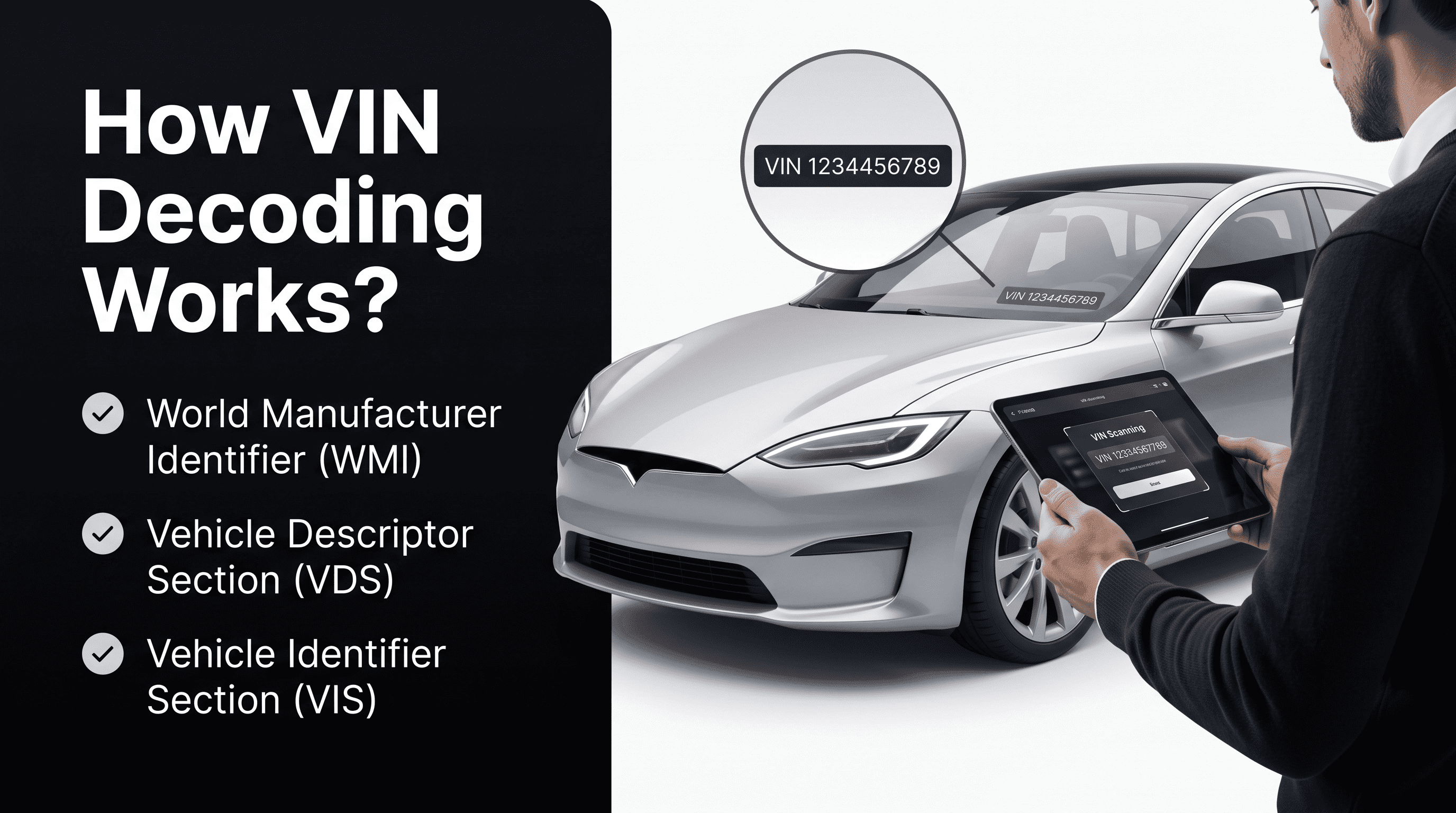
Every vehicle manufactured for modern roads is assigned a unique Vehicle Identification Number (VIN). This 17-character code acts as the vehicle's fingerprint, containing information about where it was built, who manufactured it, and many of its key specifications.
VIN decoding is the process of interpreting that information and converting it into structured vehicle data. Instead of manually reading each character of a VIN, developers and businesses use a VIN Decoder API to automatically retrieve vehicle specifications in seconds.
In this guide, we'll explain how VIN decoding works, what information a VIN contains, and why VIN decoding has become an essential part of modern automotive software.
What Is a VIN?
A Vehicle Identification Number (VIN) is a standardized 17-character identifier assigned to every modern vehicle. No two vehicles share the same VIN, making it one of the most reliable ways to identify a vehicle throughout its lifetime.
A VIN is used across the automotive industry by manufacturers, dealerships, insurance companies, fleet operators, repair shops, and government agencies to identify vehicles accurately.
A typical VIN looks like this:
1FM5K7D84DGA65208
Although it may appear to be a random combination of letters and numbers, every section of the VIN has a specific meaning.
Understanding the Structure of a VIN
A VIN is divided into three primary sections.
World Manufacturer Identifier (WMI)
The first three characters identify the manufacturer and the country where the vehicle was produced.
For example:
- 1FM → Ford Motor Company
The WMI helps identify the manufacturer before any additional decoding takes place.
Vehicle Descriptor Section (VDS)
Characters four through nine describe the vehicle itself.
Depending on the manufacturer, these characters may represent information such as:
- Body style
- Engine type
- Trim level
- Safety equipment
- Vehicle series
The ninth character is particularly important because it serves as the VIN's check digit, helping verify that the VIN has not been entered incorrectly.
Vehicle Identifier Section (VIS)
The final eight characters uniquely identify the individual vehicle.
This section typically contains:
- Model year
- Assembly plant
- Production sequence number
Together, these three sections uniquely identify both the vehicle model and the individual vehicle.
The VIN Decoding Process
VIN decoding follows a straightforward process.
Step 1: Receive the VIN
The application receives a 17-character VIN from a user, dealership system, inventory database, or another automotive service.
Example: 1FM5K7D84DGA65208
Step 2: Validate the VIN
Before decoding begins, many applications verify that the VIN is valid.
Validation typically checks:
- VIN length
- Allowed characters
- Check digit (checksum)
This helps prevent processing incomplete or incorrectly entered VINs.
If your application requires validation before decoding, consider using a VIN Validation API to verify the VIN's structure before requesting vehicle specifications.
Step 3: Decode Manufacturer Information
Once validated, the decoder interprets the VIN according to standardized rules and manufacturer-specific data.
This allows the decoder to identify details such as:
- Manufacturer
- Model Year
- Make
- Model
- Trim
- Vehicle Category
- Body Style
- Engine Specifications
- Fuel Type
- Drivetrain
Step 4: Return Structured Vehicle Data
Finally, the decoded information is returned as structured JSON that applications can use immediately.
Instead of parsing VIN characters manually, developers receive organized vehicle information that can easily be displayed, stored, or combined with other automotive data.
What Information Can Be Decoded?
A VIN Decoder can return a wide range of vehicle specifications, including:
- Model Year
- Make
- Model
- Trim
- Body Style
- Vehicle Type
- Vehicle Category
- Number of Doors
- Engine Model
- Engine Size
- Number of Cylinders
- Fuel Type
- Drive Type
- Transmission (when available)
- Manufacturer
- Assembly Plant
- Country of Manufacture
The exact information returned depends on the vehicle and the available manufacturer data.
Why VIN Decoding Matters
VIN decoding helps eliminate manual vehicle identification and improves data accuracy across automotive applications.
Common use cases include:
Dealership Software: Automatically populate inventory records using only a VIN.
Vehicle Marketplaces: Generate accurate vehicle listings without manually entering specifications.
Fleet Management: Maintain consistent vehicle records across hundreds or thousands of vehicles.
Insurance Platforms: Retrieve vehicle specifications during quoting and underwriting.
Automotive Service Applications: Identify engine configurations and vehicle details before recommending maintenance or repairs.
VIN Decoding vs VIN Validation
Although the terms are often used together, they solve different problems.
VIN validation confirms that a VIN follows the correct format by checking its length, allowed characters, and checksum.
VIN decoding extracts the information encoded within that VIN, including the vehicle's make, model, engine, body style, and manufacturer.
Many automotive applications validate a VIN first and then decode it once it has passed validation.
Build Richer Vehicle Workflows
VIN decoding is often just the beginning of a complete vehicle data workflow.
After identifying a vehicle, applications frequently retrieve additional information such as ownership history, title records, auction data, recalls, or maintenance recommendations.
Combining VIN decoding with complementary automotive APIs allows developers to build more complete vehicle intelligence platforms while keeping integrations simple and consistent.
Conclusion
VIN decoding transforms a 17-character Vehicle Identification Number into meaningful vehicle information that applications can use immediately.
Whether you're building dealership software, fleet management tools, insurance platforms, or automotive marketplaces, VIN decoding removes the complexity of interpreting VINs manually and provides reliable vehicle specifications through a simple API.
As automotive applications continue to automate vehicle identification, VIN decoding remains one of the foundational building blocks for delivering accurate and scalable vehicle data.