What Is a Vehicle History API?
Buying, selling, financing, or insuring a vehicle often requires more than knowing its make, model, and engine specifications. Understanding a vehicle's past is just as important as understanding how it was built.
This is where a Vehicle History API becomes valuable.
A Vehicle History API allows developers to retrieve historical information about a vehicle using its Vehicle Identification Number (VIN). Instead of manually collecting records from multiple sources, applications can request a vehicle history report through a single API and receive structured data that helps users make informed decisions.
Whether you're building a dealership platform, vehicle marketplace, insurance application, fleet management system, or automotive analytics platform, a Vehicle History API provides the historical insights needed to evaluate a vehicle beyond its factory specifications.
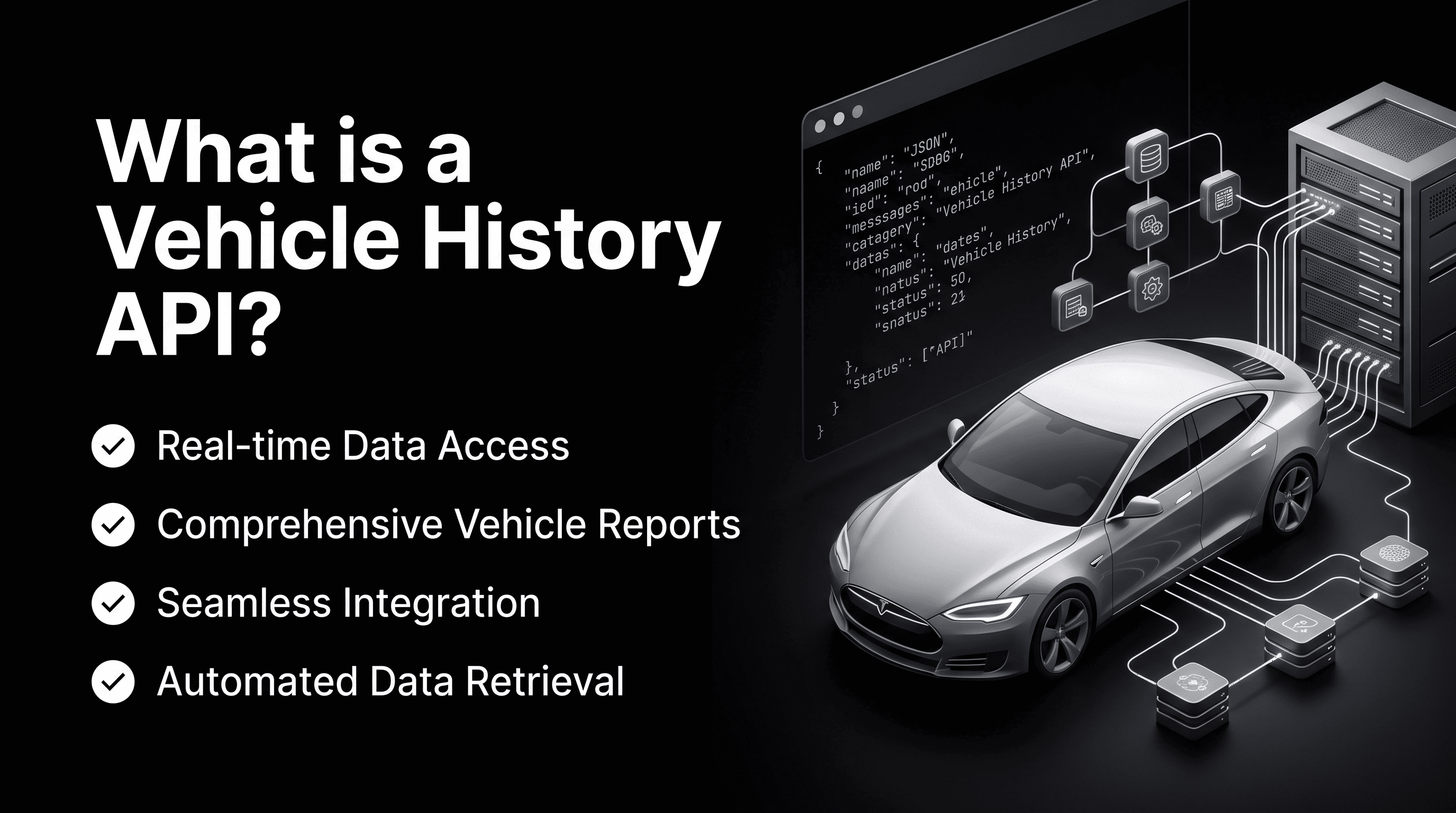
What Is a Vehicle History API?
A Vehicle History API is a web service that retrieves historical records associated with a specific vehicle.
Unlike a VIN Decoder API, which identifies how a vehicle was manufactured, a Vehicle History API focuses on events that occurred throughout the vehicle's lifetime.
These historical records may include ownership changes, title information, accident records, odometer readings, auction activity, and other vehicle-related events depending on the available data sources.
By returning structured JSON, developers can integrate vehicle history directly into their applications without manually collecting information from multiple databases.
How Does a Vehicle History API Work?
Vehicle history begins with the vehicle's VIN.
Once a VIN is submitted to the API, the service searches available data sources and compiles historical records associated with that vehicle.
A typical workflow looks like this:
- Submit a VIN.
- Verify the vehicle identifier.
- Search historical vehicle records.
- Return structured vehicle history data.
- Display the information within your application.
Because every vehicle has a unique VIN, it serves as the primary identifier for retrieving historical information.
What Information Can a Vehicle History API Return?
The exact information depends on the available data sources, but vehicle history reports commonly include records such as:
Ownership History
Track previous ownership records that help provide context about a vehicle's lifetime.
Identify title-related events that may affect the vehicle's value or ownership status.
Accident Records
View reported accident history that may help buyers and businesses better understand the vehicle's condition.
Odometer History
Review historical mileage records to help identify inconsistencies over time.
Discover whether the vehicle has appeared at vehicle auctions.
Historical auction records may include auction dates, sale information, and related details when available.
Vehicle Specifications
Many vehicle history services also return basic vehicle information including:
- Model Year
- Make
- Model
- Trim
This helps confirm that the returned history matches the intended vehicle.
Why Vehicle History Matters
Two vehicles with the same make, model, and year can have very different histories.
A vehicle that has been well maintained with a clean ownership history may represent a very different purchase than another vehicle that has experienced multiple accidents or title events.
Vehicle history helps businesses and consumers make more informed decisions by providing additional context beyond basic vehicle specifications.
Common Vehicle History API Use Cases
Vehicle History APIs support many different automotive applications.
Automotive Marketplaces
Display vehicle history alongside listings to provide buyers with additional confidence.
Dealership Software
Review historical records before purchasing or accepting trade-in vehicles.
Insurance Platforms
Access vehicle history as part of underwriting and risk evaluation workflows.
Fleet Management
Maintain historical records across commercial vehicle fleets.
Automotive Financing
Review historical vehicle information during financing and lending decisions.
Internal Business Applications
Integrate vehicle history into CRM systems, inventory software, analytics platforms, and operational workflows.
Vehicle History API vs VIN Decoder API
Although both APIs use a VIN, they answer very different questions.
A VIN Decoder API identifies the vehicle by decoding the information embedded within the VIN.
It returns specifications such as:
- Model Year
- Make
- Model
- Engine
- Body Style
- Drivetrain
- Manufacturer
A Vehicle History API focuses on what happened after the vehicle left the factory.
It provides historical records that may include:
- Ownership history
- Title information
- Accident records
- Odometer history
- Auction history
Many automotive applications use both APIs together.
First, the VIN is decoded to identify the vehicle. Then a Vehicle History API retrieves historical records associated with that specific VIN.
Vehicle History API vs Auction History API
These APIs are closely related but serve different purposes.
A Vehicle History API provides a broad view of a vehicle's lifetime by combining multiple types of historical records.
An Auction History API focuses specifically on auction events, including auction listings, sale dates, and related auction information.
If your application needs complete vehicle history, a Vehicle History API is typically the starting point. If you need detailed auction information, an Auction History API provides deeper insight into auction activity.
Build a Complete Vehicle Intelligence Workflow
Vehicle history is often one step within a larger automotive workflow.
A typical workflow may include:
- Validate the VIN using a VIN Validation API.
- Decode the VIN using a VIN Decoder API.
- Retrieve vehicle specifications with a VIN Lookup API.
- Retrieve historical records using a Vehicle History API.
- Retrieve auction records using an Auction History API.
- Check manufacturer safety campaigns using a Vehicle Recall API.
- Retrieve recommended service schedules using a Maintenance API.
Combining these APIs gives developers a more complete understanding of every vehicle while keeping integrations simple and consistent.
Frequently Asked Questions
What is a Vehicle History API?
A Vehicle History API retrieves historical records associated with a vehicle using its VIN, allowing applications to access vehicle history through a structured API response.
What information can a Vehicle History API provide?
Depending on the available data, the API may return ownership history, title information, accident records, odometer history, auction records, and basic vehicle details.
Is a Vehicle History API the same as a VIN Decoder API?
No.
A VIN Decoder API identifies how the vehicle was manufactured, while a Vehicle History API provides information about events that occurred throughout the vehicle's lifetime.
Can I use a Vehicle History API in dealership software?
Yes. Dealerships commonly use vehicle history to evaluate trade-ins, verify inventory, and provide buyers with additional information.
Why should I retrieve vehicle history before purchasing a vehicle?
Vehicle history provides valuable context that may not be visible during a physical inspection. Reviewing historical records helps buyers and businesses make more informed decisions.
Can Vehicle History APIs be combined with other automotive APIs?
Yes. Vehicle History APIs are commonly used alongside VIN Validation, VIN Decoder, VIN Lookup, Auction History, Vehicle Recall, and Maintenance APIs to build complete automotive applications.
Conclusion
A Vehicle History API helps developers retrieve historical information that goes beyond basic vehicle specifications.
While a VIN Decoder identifies what a vehicle is, a Vehicle History API helps explain what that vehicle has experienced throughout its lifetime.
For dealerships, insurance providers, fleet operators, automotive marketplaces, and software developers, combining vehicle history with VIN decoding, validation, recalls, auction data, and maintenance information creates a more complete view of every vehicle and supports better business decisions.